1 in 10
affected patients dies from their HAI, on average.

The A1 adds a supplemental step to your cleaning and disinfection protocols, strengthening overall patient safety while maintaining seamless operations.
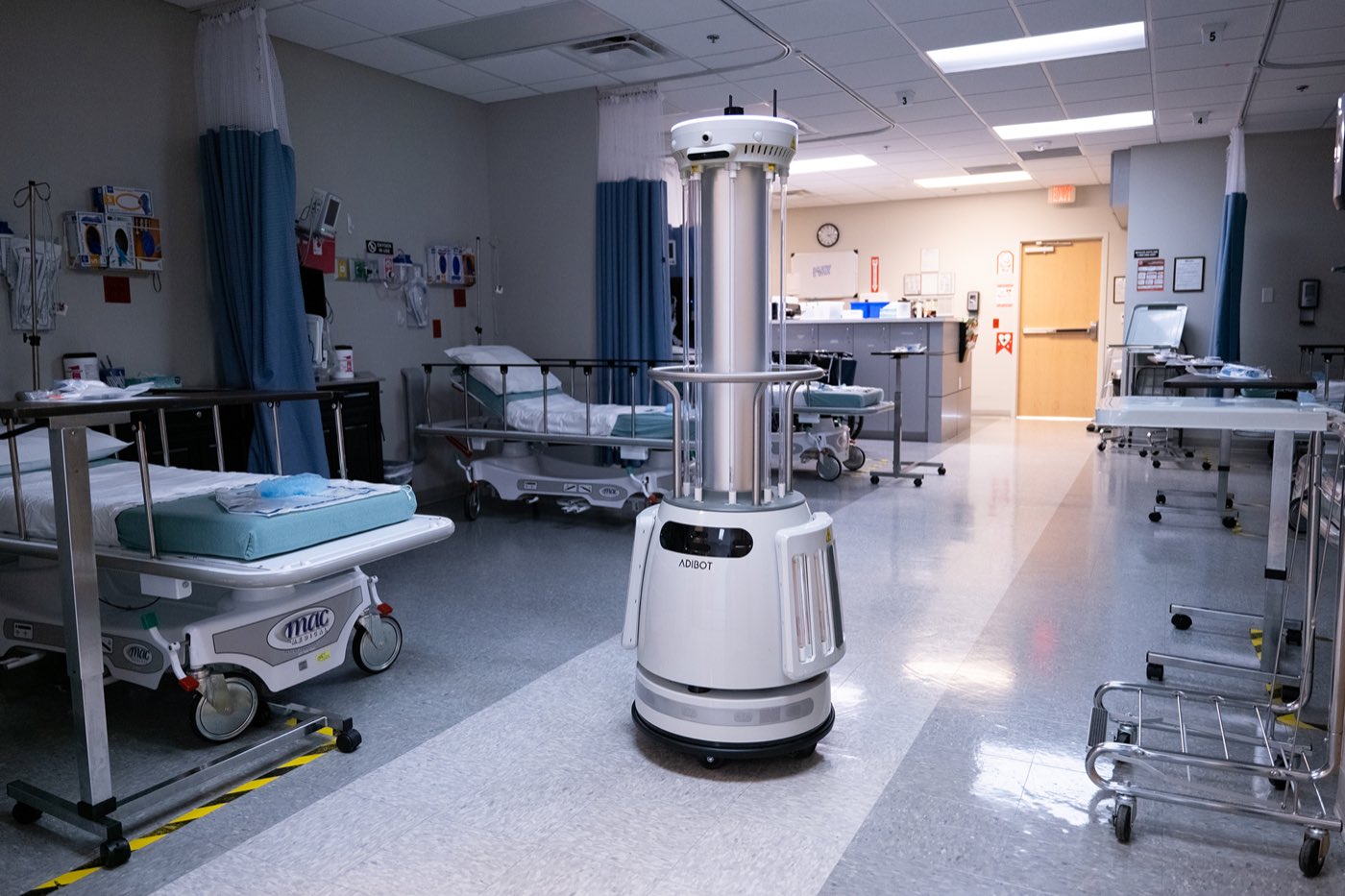
Healthcare-associated infections (HAIs) harm patients and place additional demands on care teams and health systems. Manual cleaning and disinfection depend on reaching the surfaces in scope, applying an appropriate product correctly and allowing its required contact time. A missed surface or incomplete application can leave a gap, and what is missed can carry to the next patient.
1 in 10
affected patients dies from their HAI, on average.
51%
of evaluated surfaces missed the study’s cleaning criterion.
70%
lower HAI spread risk with good infection prevention and control.
WHO reported HAI acquisition estimates of 7 and 15 per 100 acute-care patients during their hospital stay, for the two country income groups defined below.
WHO’s formal economic classifications are “high-income countries” (7 in 100) and “low- and middle-income countries” (15 in 100). These are distinct population estimates, not a universal range.
In the REACH trial across 11 Australian hospitals, fluorescent-marker assessments found that 55% of frequent-touch points in bathrooms and 64% in bedrooms were cleaned before the intervention. A program addressing products, technique, training, auditing and communication improved those figures to 76% and 86%.
Published 2019; intervention conducted in 2016–2017. These are cleaning-thoroughness measures from participating hospitals, not microbial-reduction results or a worldwide cleaning rate. This study evaluated a cleaning program, not the A1. Read the REACH trial.
Germicidal UV-C at 254 nm is not new. Water treatment, air handling, laboratories, and pharmaceutical cleanrooms have relied on it for decades as a physical, chemical-free disinfection step. What has changed is how it reaches the spaces where risk is highest. This is why teams are adding UV-C to their environmental disinfection process.
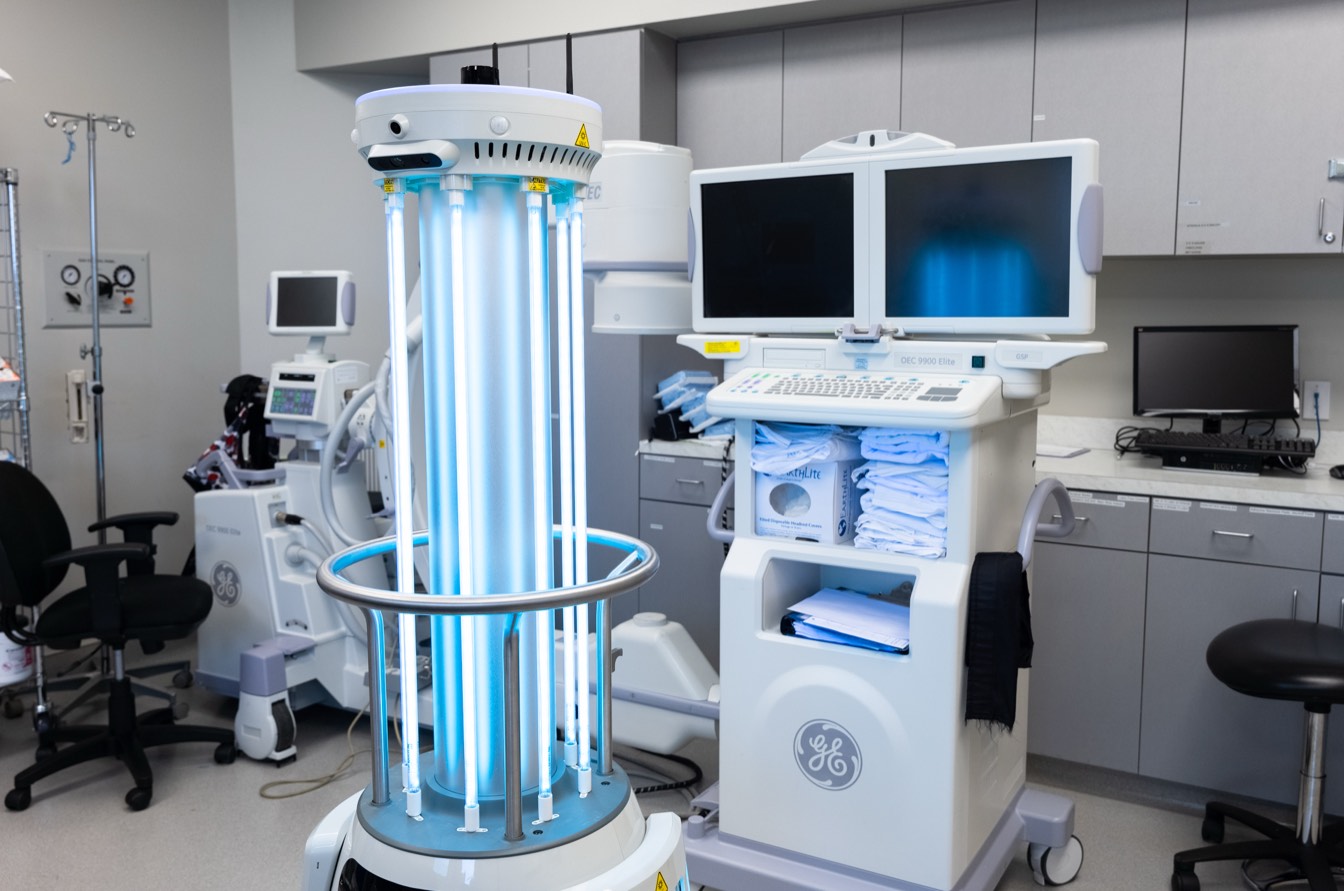
Automated disinfection programs are built and scheduled in advance, not left to an individual’s discretion. That removes the human error manual protocols are prone to.
UV-C’s germicidal effect on microorganisms is one of the most well-studied disinfection methods in healthcare, backed by decades of peer-reviewed research. Dosage can also be measured and verified, confirming a room received the exposure it was meant to.
Team members set a room’s disinfection program, then move on to other work while the A1 runs it independently. The cycle completes without supervision, freeing staff time for the work that actually needs their attention.
In a nine-hospital, cluster-randomized study, adding UV-C to standard terminal cleaning cut patients’ risk of acquiring a targeted multidrug-resistant organism or C. difficile infection by 30%.
A third-party laboratory evaluated the A1 against seven microorganisms on stainless-steel test surfaces in a furnished mock patient room of approximately 23 m² (250 ft²). The A1 completed the cycle in under 10 minutes, autonomously. Test locations included horizontal and vertical surfaces.
>99.9%
Reduction of C. difficile spores at every tested location
>99.99%
Reduction of MRSA at every tested location
Our team will contact you to discuss the findings and provide the reports.
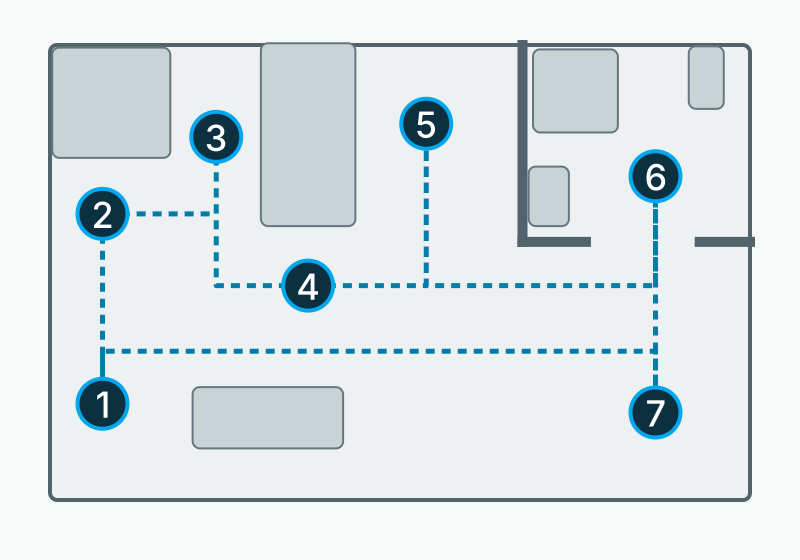
A worker in scrubs pushes a stationary UV-C device to each of seven positions in a patient room and its bathroom. At each one they run the power cord to a wall outlet, leave the room while the cycle runs, and come back to move the device on. Before the fourth position they unplug it and use an outlet on the back wall. Cyan light illustrates proximity and line of sight; it is not a measured dose map. The device, robot and room are schematic.
Used properly, a stationary device turns one patient room into a series of trips. Someone wheels it to the first position, runs the cord to an outlet and steps out while the cycle runs. Then they come back to move it, and again for every position after that, re-plugging whenever the cord won’t reach.
The A1 runs the room’s saved program on its own. It drives to each position in sequence, applies the exposure set for that position, and moves on. Once the cycle starts, nobody needs to stay with it, so your team is free to get on with other critical work, like preparing and cleaning the next room.
The A1 adds UV-C to your protocol without adding to your team’s workload.
Most objections to UV-C in hospitals were earned by stationary devices. They are objections to the workflow, not the wavelength. A hospital ran a single A1 across its OR suite and patient rooms, completing 864 autonomous disinfection tasks — 275.7 hours of active runtime across 87 of 90 days, averaging 3.06 hours a day. Six months after implementation it was already routine — running outside operating hours, at roughly a third of the unit’s daily capacity. Below are the three misconceptions that deployment dismantled.
Stationary devices come with a process: wheel it in, find an outlet, position it, program the cycle, clear the room, wait, reposition, repeat. Every added step is a reason for a short-staffed shift to skip it — and a protocol that gets skipped never becomes routine.
In use on 87 of 90 days, six months after implementation. All 510 cycles in the OR suite ran in that unit’s off-hours, beginning between 9:32 PM and 4:46 AM; a typical night’s block started at 10:21 PM and covered seven of the unit’s eight rooms by 2:46 AM. One month after the period closed, the hospital added two more units to complete its fleet.
Cycles in the OR suite ran during “off-hours”
Units added April 2024
With a stationary unit, every disinfection position is a trip in and out of the room. Coverage and labor grow together — so larger rooms get fewer positions, or none.
Task length followed room size, not staff availability. An OR suite ran close to twice as long as a patient room because it required more disinfection points — yet what the program asked of staff stayed constant: start the task, collect the unit.
OR suite, n=510
Patient rooms, n=343
Mean task duration, 853 completed tasks (98.7% of qualifying tasks). Categories with too few observations excluded.
Manual repositioning keeps an operator tethered to the room: walk in, move, walk out, wait, repeat. That standby time is the silent cost of the program.
The A1 made every transition between disinfection points on its own. Recreating the same programs with a stationary device would require two repositionings for the patient room and ten for the OR suite — each one a trip back into the room.
Patient room · Use-Map · 3 points
OR suite · AI Auto Explore · 11 points
Stationary times are estimates from anecdotal accounts of manual use: repositioning, locating an outlet, powering on, re-setting the task. Room preparation time excluded.
Every minute the A1 spends on a task is a minute your team can spend on other high-priority work throughout the hospital.
Projected annual staff hours reclaimed
“The A1 has been a great
addition to our team!”
The case study above shows what the A1 does in a real hospital. This simulation shows how. Even when targeting a single disinfection point, the A1’s UV-C light reaches the surfaces around it, adding to the room’s cumulative dosage as the program runs. Because of this, the A1 is able to rapidly and precisely distribute 100 mJ/cm² of UV-C energy across every surface and achieve at least a 99.99% reduction of C. diff.
Third-party laboratory testing measured reductions of specific microorganisms that cause the spread of HAIs on test surfaces under stated conditions; laboratory reductions do not establish a reduction in patient infection rates. HAI outcomes depend on the whole infection prevention program including hand hygiene, cleaning and disinfection, isolation practice, antimicrobial stewardship and surveillance. Read more: Measured laboratory reductions.
No. UV-C is an additional surface-treatment step, not a substitute for manual cleaning, which remains a separate requirement. UV-C delivers energy to exposed surfaces to inactivate microbes; it does not remove soil or residue, and soil left on a surface can shield the microbes beneath it. The practical sequence is unchanged: clean as your procedures require, then run UV-C as a defined step within the wider infection prevention strategy. Read more: Making UV-C work with your cleaning routine.
After the room has been cleaned and disinfected as required. Staff prepare the space — identifying the surfaces in scope and arranging the room to limit shadowed areas — then time the cycle to an unoccupied window, such as between patient rounds or while an OR is between cases. The A1 runs its saved program of positions and exposure times before the room returns to use.
Request a demo to walk a representative room.
A third-party laboratory evaluated the A1 against seven microorganisms on stainless-steel test surfaces in a furnished mock patient room of approximately 23 m² (250 ft²), at multiple locations across horizontal and vertical surfaces, in an autonomous cycle completed in under 10 minutes. It recorded more than 99.9% reduction of C. difficile spores and more than 99.99% reduction of MRSA at every tested location. Read more: All seven laboratory results.
Request the laboratory reports — TGR discusses test methods with your team directly.
With an autonomous device, there’s no babysitting required. Stationary UV-C devices that have to be manually repositioned require an operator to place the unit, start an exposure, leave, return, move it to the next point and repeat — every position is another trip, so in practice larger rooms get fewer positions or none. The A1 moves between its established positions on its own: staff prepare the room, start the task, and collect the unit. The disinfection program is saved and can be repeated for future tasks. Read more: Common misconceptions about UV-C.
People can stay in the building during a cycle, but no one may be in the room where the A1 is running. UV-C exposure can injure the eyes and skin, so the treated space must be unoccupied with controlled access for the whole cycle. Because of this, the A1 is equipped with motion sensors and a smart safety sign, and either one pauses disinfection when triggered. Read more: Understanding UV-C safety precautions.
ADIS, the A1’s reporting and fleet management system, records data for every disinfection task completed by the A1. Teams can generate and export reports on demand while monthly summaries support documentation and are delivered via email. Read more: ADIS fleet reporting.