

The Inverse Square Law and UV-C Disinfection
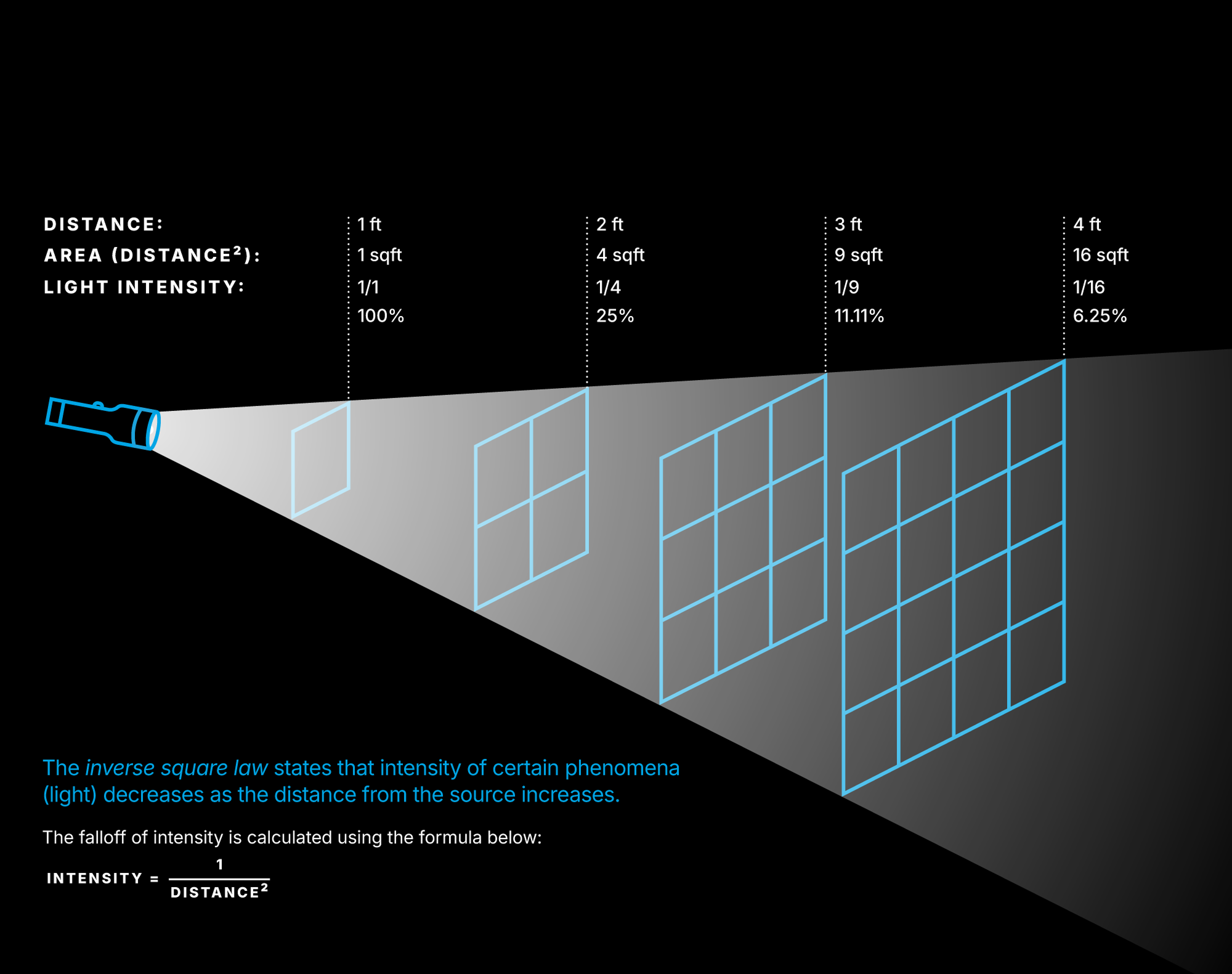
UV-C intensity doesn't fade across a room - it collapses. See how the inverse square law governs dose, and why autonomous repositioning answers the physics.
Ultraviolet-C light inactivates microorganisms by damaging their DNA and RNA so they can no longer replicate. Whether that inactivation actually happens on a given surface comes down to one variable that is easy to underestimate: distance. UV-C intensity does not fade gently as it crosses a room. It collapses. Understanding why is the difference between a disinfection cycle that works and one that only looks like it does.
What the Inverse Square Law Says
The inverse square law describes how the intensity of energy radiating from a source decreases as it spreads out from that source. The same fixed amount of light energy has to cover an ever-larger area as it travels outward, so the energy landing on any one patch of surface drops in proportion to the square of the distance.
The consequence is steep. Doubling the distance from a source does not halve the intensity — it quarters it. Tripling the distance cuts intensity to roughly one-ninth. The falloff is not linear; it accelerates.
Irradiance, Dose, and Why Both Matter
Two terms carry the entire concept.
Irradiance is the rate at which UV-C energy arrives at a surface — power per unit area, measured in microwatts per square centimeter (µW/cm²). Irradiance is what the inverse square law governs.
Dose is irradiance multiplied by time, measured in millijoules per square centimeter (mJ/cm²). Dose is what actually inactivates microorganisms. Every organism has a required dose: MRSA requires roughly 36 mJ/cm² for a greater-than-Log-4 (99.99%) per-surface reduction; the more resilient C. difficile requires roughly 100 mJ/cm².
Because dose is irradiance times time, a surface receiving one-ninth the irradiance needs nine times the exposure to reach the same dose. Distance does not just dim the light. It multiplies the time required to disinfect — or, if the time is fixed, it leaves distant surfaces short of the dose they need.
The Falloff, in Numbers
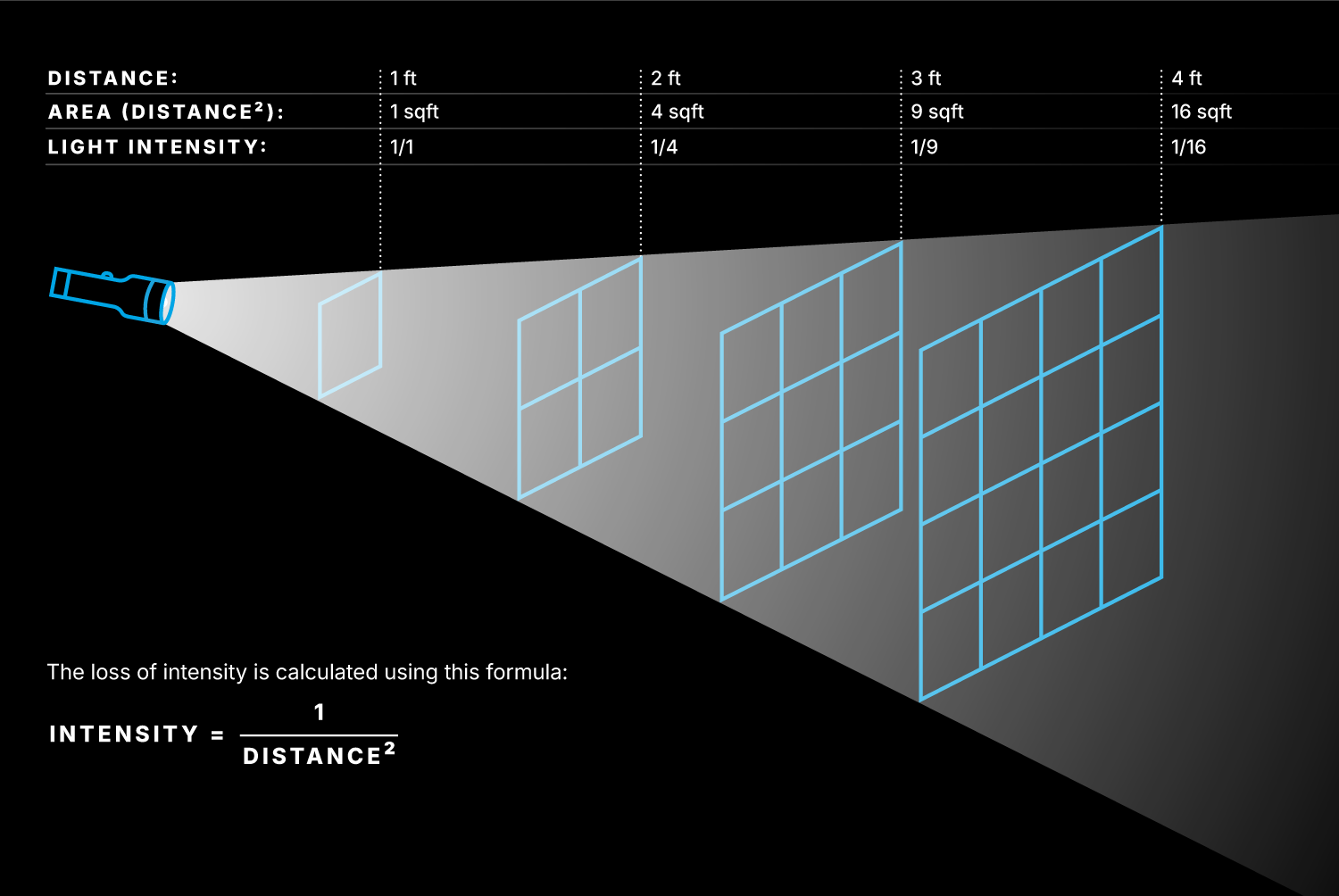
The following table uses irradiance at one meter as the baseline. The A1's lamp array produces a total UV-C intensity of 1,520 µW/cm² at one meter, which anchors the illustration.
Read the right-hand column as the operational cost of distance. A surface five meters from a source needs twenty-five times the exposure of a surface one meter away to receive the same disinfecting dose. A single emitter parked in the corner of a room is asking the far wall to sit in weak light for an impractically long time — while the near wall is flooded far beyond what it needs.
One Worked Example
Using the verified 1,520 µW/cm² at one meter, an idealized surface at that distance accumulates the 100 mJ/cm² needed for C. difficile in a little over a minute. Move that same surface to three meters and the required exposure stretches to roughly ten minutes for the identical result. Nothing about the pathogen changed. Only the distance did.
A Note on Precision
The inverse square law is the idealized point-source model. Real UV-C fixtures are extended sources — the A1 carries a tall column of lamps rather than a single point — so the true falloff is gentler than a pure square close to the fixture and approaches the square law at room-scale distances. The illustrative times above should be read as directional rather than as performance specifications. The governing takeaway holds regardless of the model's precision: irradiance drops sharply with distance, and dose has to be engineered around that fact.
Why a Fixed Source Fights the Physics
A stationary UV-C device has one relationship to every surface in the room, and that relationship is fixed by wherever it was placed. Surfaces close to it are overdosed. Surfaces far from it are underdosed. There is no single position and no single run time that resolves this, because the inverse square law guarantees that the near and far surfaces are living in different dose environments the entire cycle.
The conventional workaround is to move the device by hand to several positions and run a separate cycle from each — repositioning between cycles and supervising throughout. That works, but it converts a physics problem into a labor problem, and it makes the outcome depend on whether each manual placement was correct and consistent.
How Autonomy Answers the Physics
The A1 ADIBOT addresses the inverse square law by refusing to disinfect an entire room from one place. It repositions to multiple strategically located disinfection points, keeping every surface within an effective working distance of the lamp array rather than stranding the far corners in collapsed irradiance. Casting UV-C from several positions also reduces shadowing, since UV-C is line-of-sight and only inactivates microorganisms on surfaces in direct exposure.
The A1 executes this repositioning autonomously, through mapped points or AI-generated exploration, reducing human intervention rather than replacing the staff who direct it. The robot handles the geometry the inverse square law imposes, consistently, every cycle, so that dose is delivered where it is actually needed.
UV-C is one measured, repeatable layer within a broader contamination control strategy — an adjunct to routine cleaning, not a replacement for it. What autonomy adds is the ability to honor the physics of distance at every point in the room, without asking a person to solve that equation by hand.
Frequently Asked Questions
What is the inverse square law in UV-C disinfection?
The inverse square law states that UV-C irradiance decreases in proportion to the square of the distance from the light source. In practice, doubling the distance from a UV-C lamp reduces the intensity reaching a surface to one-quarter, and tripling the distance reduces it to about one-ninth. This is why distance is the single most important variable in whether a surface receives an effective disinfecting dose.
How does distance affect UV-C dose?
Distance affects UV-C dose because dose equals irradiance multiplied by exposure time, and irradiance falls with the square of distance. A surface three times farther from the source receives about one-ninth the irradiance, so it needs roughly nine times the exposure to reach the same dose. If exposure time is held constant, distant surfaces receive far less dose than nearby ones.
What is the difference between UV-C irradiance and UV-C dose?
Irradiance is the rate at which UV-C energy arrives at a surface, measured in microwatts per square centimeter (µW/cm²), and it is governed by distance through the inverse square law. Dose is irradiance multiplied by time, measured in millijoules per square centimeter (mJ/cm²), and it is what actually inactivates microorganisms. A high irradiance for a short time and a low irradiance for a long time can deliver the same dose.
How much UV-C dose is needed to inactivate common pathogens?
The required dose depends on the organism. Per-surface targets for a greater-than-Log-4 (99.99%) reduction are approximately 36 mJ/cm² for MRSA, 13 mJ/cm² for VRE, and 100 mJ/cm² for the more resilient Clostridium difficile. These are per-surface dose targets confirmed by digital dosimeter, distinct from whole-room field results.
Why does UV-C intensity drop so quickly across a room?
UV-C intensity drops quickly because the light energy radiating from a source spreads across an increasingly large area as it travels, so the energy landing on any single surface falls with the square of the distance. The falloff accelerates rather than staying steady, which means the far side of a large room can receive only a small fraction of the intensity reaching surfaces near the source.
Why is an autonomous UV-C robot more effective than a stationary device?
An autonomous UV-C robot repositions to multiple points within a room, keeping each surface within an effective working distance of the lamps rather than disinfecting the entire space from a single fixed position where distant surfaces are underdosed. The ADIBOT A1 does this without manual repositioning between cycles, and disinfecting from several positions also reduces shadowing because UV-C only reaches surfaces in direct line of sight.
Does UV-C disinfect surfaces that are not in direct line of sight?
No. UV-C is line-of-sight and only inactivates microorganisms on surfaces it directly reaches, so shadowed areas receive little or no dose. Repositioning the source to multiple angles reduces shadowing, which is one reason an autonomous robot that moves through a room can cover more surfaces than a fixture that emits from a single fixed position. UV-C is intended as an adjunct to routine manual cleaning, not a replacement for it.


%2C%20Color%3DNegative.png)

