


Rethinking Environmental Disinfection
In high-risk environments, the cost of a missed surface isn't measured in oversight — it's measured in outcomes. Manual protocols set the standard, but physical limitations mean the gap rarely closes on its own.
Prevention Has Its Limits.
Maintaining a clean and disinfected environment is one of the most critical and difficult responsibilities in any high-occupancy, high-turnover facility. On average, one in 38 occupants in these environments acquires an infection during their time there, contributing to an estimated $28.4–$45 billion in associated costs annually in the U.S. alone. Globally, an estimated 136 million infection cases tied to environmental exposure occur every year.
The issue isn't protocol — it's physics. No matter how rigorous the cleaning procedure, there are surfaces that are difficult to reach, angles that are easy to miss, and overhead equipment that rarely receives the attention it requires. Those are the gaps where infection takes hold — and where environmental services teams, no matter how well-trained or well-equipped, face an unavoidable structural limitation.
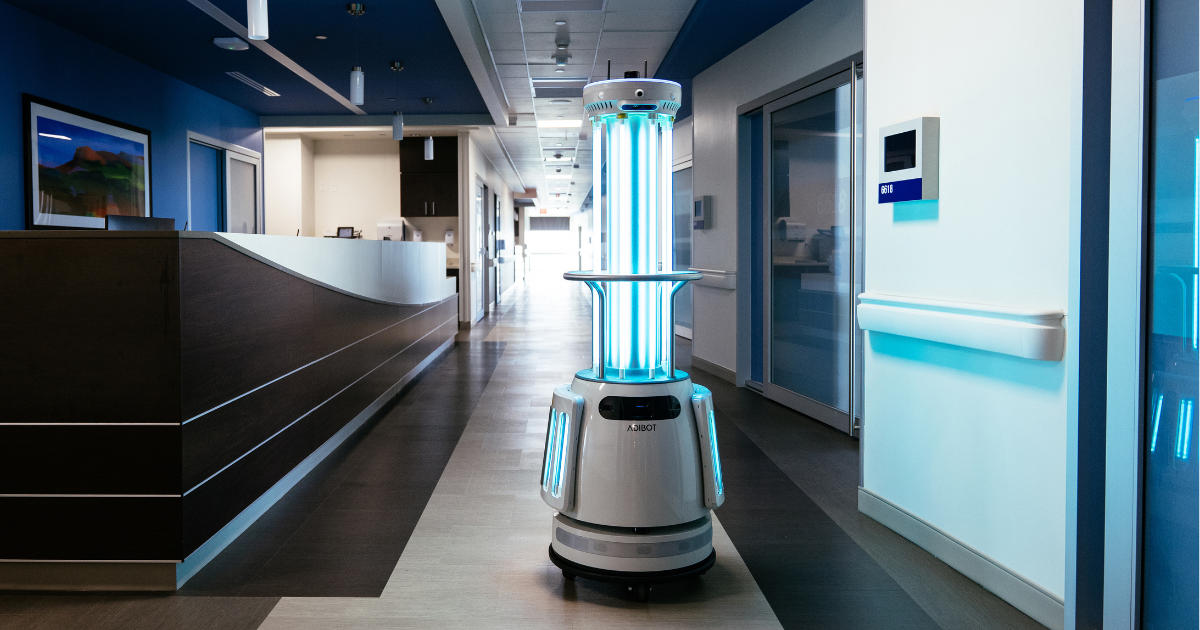
Contamination isn’t an edge case. It’s a constant.
A trusted, disinfection method deployed across regulated industries for decades — from water treatment and food processing to semiconductor manufacturing — UV-C has a long track record of performing where consistency and documentation matter most.
A Brief History of UV-C
Arthur Downes and Thomas Blunt observe that sunlight inhibits bacterial growth in test tubes.
Niels Finsen receives the Nobel Prize in Physiology or Medicine for treating disease with concentrated light radiation.
UV-C germicidal fixtures begin appearing in high-occupancy controlled environments where the consequences of airborne and surface pathogen transmission are most severe.
As awareness of surface and airborne transmission grows, UV-C expands from supplemental air disinfection into broader surface disinfection applications across high-risk, high-turnover facilities.
Autonomous UV-C robots enter high-occupancy facilities at scale, enabling environmental services teams to deliver consistent, documentable disinfection cycles without adding burden to already stretched staff. The technology shifts from a novel intervention to a recognized layer within modern environmental disinfection programs.


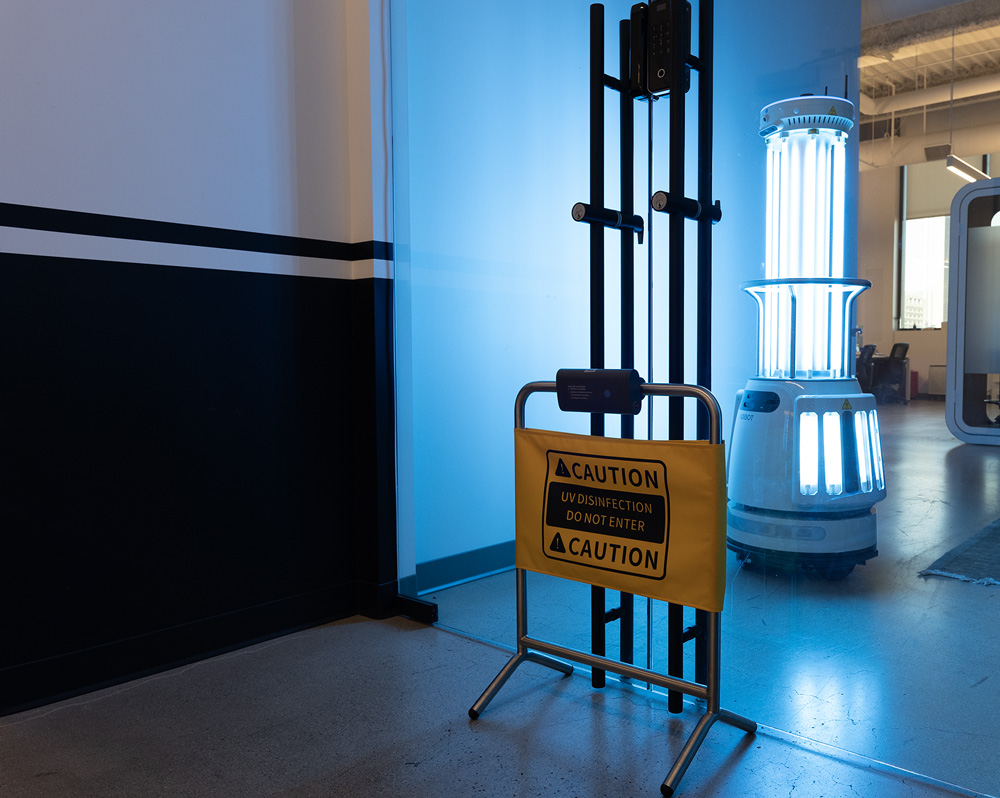
Why Environmental Services Teams Are Adding UV-C Robots
UV-C isn't new to these environments. What's new is removing the manual burden that used to come with it.
UV-C delivery is based on physics — not technique. Automated, germicidal output is consistent, repeatable, and unaffected by operator variability — delivering the same result in every room, every time.
Dosage can be quantified and verified in real time using dosimeters, giving environmental services and infection control teams documented evidence that the required level of germicidal exposure was achieved — not just that a protocol was followed.
UV-C is not a replacement for manual cleaning and disinfection — it’s a force multiplier. It works alongside existing cleaning protocols to close the coverage gaps that even well-trained, well-equipped teams cannot fully eliminate on their own.
UV-C light cannot penetrate glass or plastic, and autonomous systems are equipped with human presence detection that immediately suspends operation upon entry — so the technology that protects the environment never puts the people in it at risk.
Microbial Reduction by Pathogen Target
Decades of peer-reviewed research have established clear, pathogen-specific UV-C dose thresholds for achieving meaningful microbial reduction. The table below reflects that data and the standard against which every disinfection session should be measured.
| Microbe | Dose required | Log reduction |
|---|---|---|
| Clostridium difficile (C. diff) | 100 mJ/cm² | > Log 4 (99.99%) |
| Candida auris (C. auris) | 90 mJ/cm² | > Log 4 (99.99%) |
| Methicillin-Resistant Staphylococcus aureus (MRSA) | 36 mJ/cm² | > Log 4 (99.99%) |
| Vancomycin-Resistant Enterococcus (VRE) | 13 mJ/cm² | > Log 4 (99.99%) |
| Acinetobacter baumannii (A. baumannii) | 9 mJ/cm² | > Log 4 (99.99%) |
Published UV-C dose thresholds for representative microorganisms, with the corresponding log reduction at target dose. Figures reflect target-dose performance on directly exposed surfaces, verified by digital dosimeter — not a whole-room result. UV-C is line-of-sight and works as an adjunct within a broader contamination control strategy, never a replacement for routine cleaning.


%2C%20Color%3DNegative.png)

