Reliable
Physics, not technique. Automated output is consistent and unaffected by operator variability — the same programmed sequence and exposure times in every room, every time.

In high-risk environments, the cost of a missed surface is measured in outcomes. Keeping these facilities clean and disinfected falls on staff already stretched thin. Turnover is high, shifts run lean, and teams cover more ground in less time as the standard gets stricter.
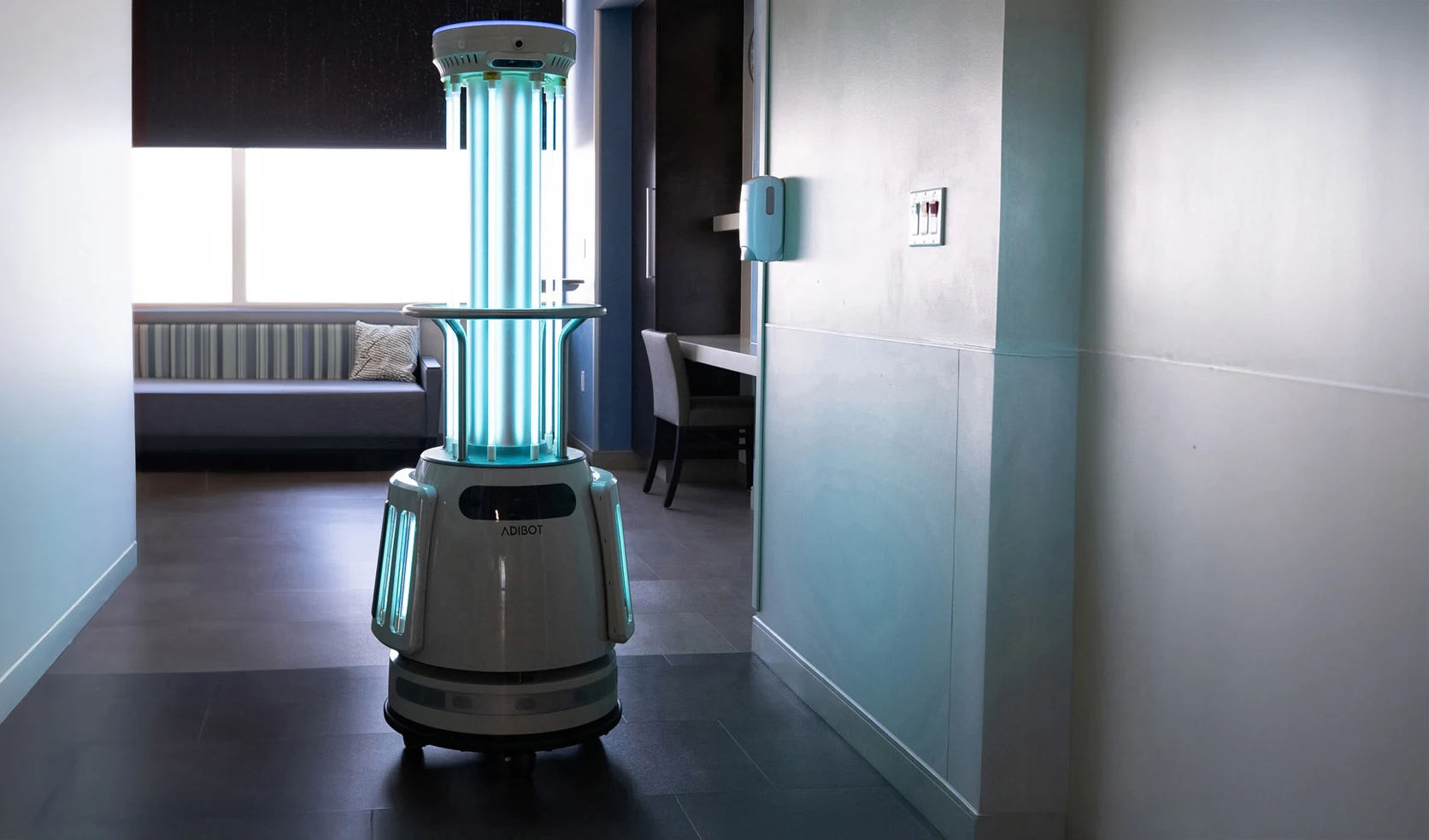
Manual protocols set the bar, but their limits mean the gaps rarely close on their own. Shared surfaces are everywhere and often hard to reach, while cleaning and disinfection techniques vary by person and shift. Rooms are needed back fast, so any added step competes with the schedule and gets skipped. Human error is a property of manual work under time pressure, not a training gap. What’s missed stays on the surface until the next clean.
Inconsistent cleaning and disinfection practices can lead to errors or missed spots.
Some pathogens are highly resistant to standard disinfectants.
Pathogens left behind can survive on surfaces for days to months.
Germicidal UV-C at 254 nm is not new. Water treatment, air handling, laboratories, and pharmaceutical cleanrooms have relied on it for decades as a physical, chemical-free disinfection step. What has changed is how it reaches the spaces where risk is highest. That is why facility teams are adding UV-C to their disinfection programs.
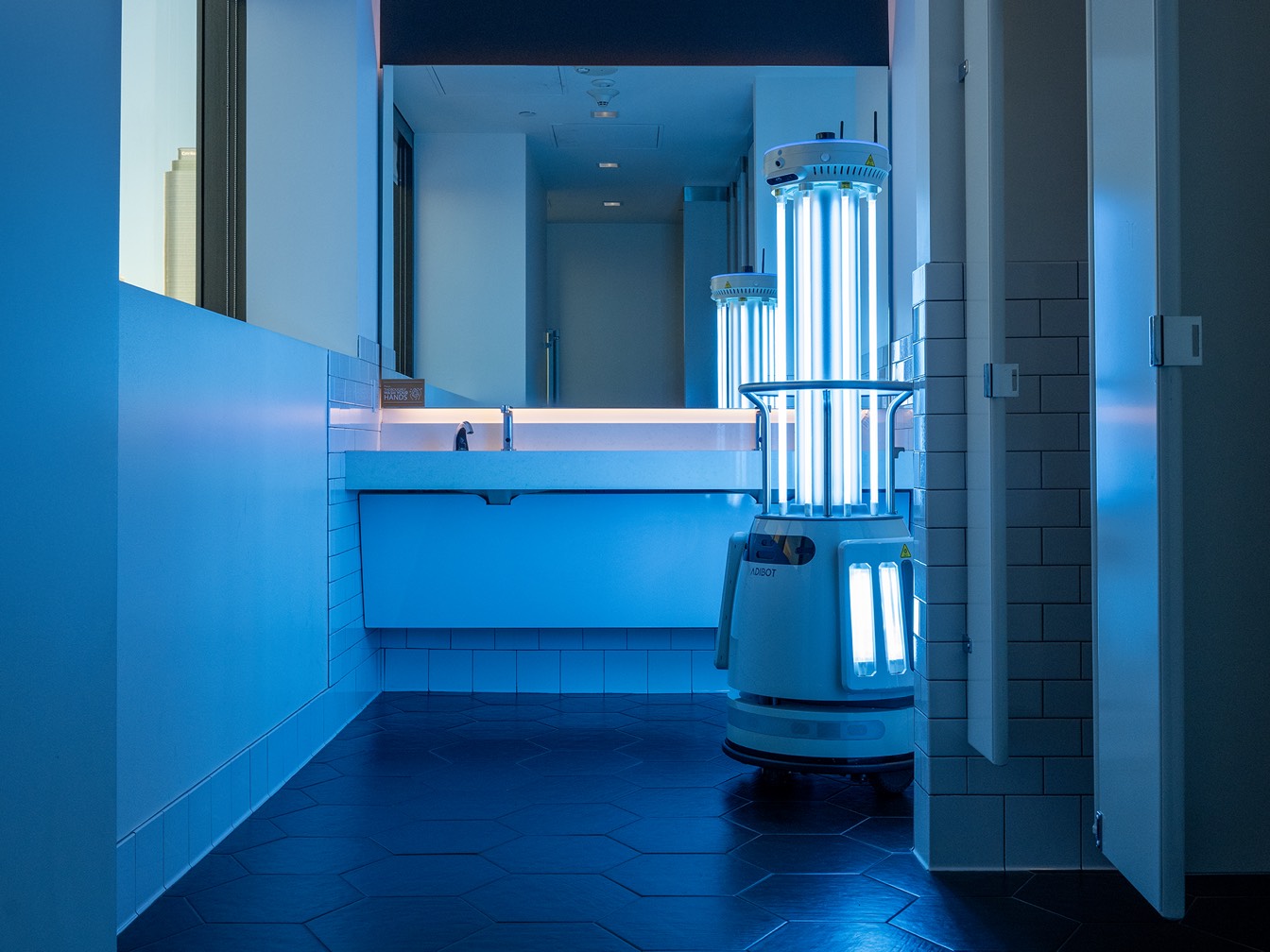
Physics, not technique. Automated output is consistent and unaffected by operator variability — the same programmed sequence and exposure times in every room, every time.
Automated reporting turns every cycle into an audit-ready record of what was treated, when, and for how long.
Runs on a schedule or on demand once a room is empty, without staff repositioning it, so throughput never waits.
Human presence detection pauses UV-C when someone enters the room.
A third-party laboratory evaluated the A1 against seven microorganisms on stainless-steel test surfaces in a furnished room of approximately 250 ft². The A1 completed the cycle in under 10 minutes, autonomously. Test locations included horizontal and vertical surfaces.
>99.9%
Reduction of C. difficile spores at every tested location
>99.99%
Reduction of MRSA at every tested location
Our team will contact you to discuss the findings and provide the reports.
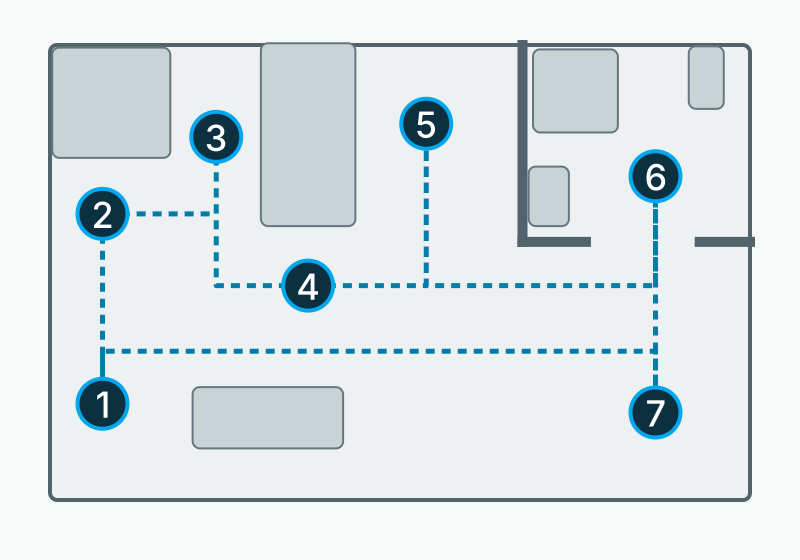
A worker pushes a stationary UV-C device to each of seven positions in a furnished room and an adjoining space. At each one they run the power cord to a wall outlet, leave the room while the cycle runs, and come back to move the device on. Before the fourth position they unplug it and use an outlet on the back wall. Cyan light illustrates proximity and line of sight; it is not a measured dose map. The device, robot and room are schematic.
Used properly, a stationary device turns one room into a series of trips. Someone wheels it to the first position, runs the cord to an outlet and steps out while the cycle runs. Then they come back to move it, and again for every position after that, re-plugging whenever the cord won’t reach.
The A1 runs the room’s saved program on its own. It drives to each position in sequence, applies the exposure set for that position, and moves on. Once the cycle starts, nobody needs to stay with it, so your team is free to get on with other critical work, like preparing and cleaning the next room.
The A1 adds UV-C to your protocol without adding to your team’s workload.
Most objections to UV-C in high-risk facilities were earned by stationary devices. They are objections to the workflow, not the wavelength. A high-risk facility ran a single A1 across various room types, completing 864 autonomous disinfection tasks — 275.7 hours of active runtime across 87 of 90 days, averaging 3.06 hours a day. Six months after implementation it was already routine — running during off-hours, at roughly a third of the unit’s daily capacity. Below are the three misconceptions that deployment dismantled.
Stationary devices come with a process: wheel it in, find an outlet, position it, program the cycle, clear the room, wait, reposition, repeat. Every added step is a reason for a short-staffed shift to skip it — and a protocol that gets skipped never becomes routine.
In use on 87 of 90 days, six months after implementation. All 510 cycles in the 500 ft² rooms ran in that unit’s off-hours, beginning between 9:32 PM and 4:46 AM; a typical night’s block started at 10:21 PM and covered seven of the unit’s eight rooms by 2:46 AM. One month after the period closed, the facility added two more units to complete its fleet.
Cycles in the 500 ft² rooms ran during “off-hours”
Units added April 2024
With a stationary unit, every disinfection position is a trip in and out of the room. Coverage and labor grow together — so larger rooms get fewer positions, or none.
Task length followed room size, not staff availability. A 500 ft² room ran close to twice as long as a 275 ft² room because it required more disinfection points — yet what the program asked of staff stayed constant: start the task, collect the unit.
500 ft², n=510
250–275 ft², n=343
Mean task duration, 853 completed tasks (98.7% of qualifying tasks). Categories with too few observations excluded.
Manual repositioning keeps an operator tethered to the room: walk in, move, walk out, wait, repeat. That standby time is the silent cost of the program.
The A1 made every transition between disinfection points on its own. Recreating the same programs with a stationary device would require two repositionings for the 275 ft² room and ten for the 500 ft² room — each one a trip back into the room.
275 ft² · Use-Map · 3 points
500 ft² · AI Auto Explore · 11 points
Stationary times are estimates from anecdotal accounts of manual use: repositioning, locating an outlet, powering on, re-setting the task. Room preparation time excluded.
Every minute the A1 spends on a task is a minute your team can spend on other high-priority work throughout the facility.
Projected annual staff hours reclaimed
“The A1 has been a great
addition to our team!”
No. Cleaning is a separate, prior step and stays in the procedure. UV-C does not remove soil, dust or residue, and material left on a surface can shield what is underneath it from the light. The working order is: clean and disinfect the room as your procedures require, then run the UV-C cycle as an additional pass over surfaces that pass may have missed. Read more: Making UV-C work with your cleaning routine.
People can stay in the building during a cycle, but no one may be in the room where the A1 is running. UV-C exposure can injure the eyes and skin, so the treated space must be unoccupied with controlled access for the whole cycle. Because of this, the A1 is equipped with motion sensors and a smart safety sign, and either one pauses disinfection when triggered. Read more: Built-in safety sensors.
They are not treated. UV-C is line-of-sight: it disinfects surfaces the light directly reaches, and the energy delivered drops as distance increases and as surfaces angle away from the source. Undersides, interiors, and anything behind furniture or equipment stay shadowed. Treating from several positions rather than one reduces how much stays in shadow, which is why the A1 is fully autonomous and navigates to multiple areas within a room for comprehensive coverage. Read more: UV-C dose and exposure.
The A1 can disinfect a 250 ft² room in ~13 minutes when targeting 4-log reduction (99.99%) of C. diff, and up to roughly 36 rooms on a charge, with about 8 hours of runtime. Total disinfection times vary based on room size, point count, target organism and reduction goal. Read more: A1 specifications.
Talk to TGR with a floor plan and get an estimate for your own rooms.
A stationary unit has to be manually moved around the room in between cycles for repositioning while the A1 makes every transition between points itself. Read more: Common misconceptions about UV-C.
ADIS, the A1’s Autonomous Deployment Information System, is included with every purchase at no extra cost. The platform records operating time and cycle completion by area, robot, operating mode and operator. Reports can be generated and exported on demand while monthly summaries are shared via email. Read more: ADIS fleet reporting.
Delivery includes an implementation plan, on-site setup by our Customer Experience team and up to 16 hours of on-site training with options to extend. After that, support tickets are resolved within one business day and loaner units are deployed within two. Each A1 is backed by five years of coverage: one free year of limited warranty, followed by four years of extended coverage. Read more: Support and ownership.
Contact customer support for an existing unit, or talk to TGR before a purchase.